Practice coding.
Bring your friends.
Choose a set of JavaScript problems and work through them with friends. Everyone gets their own editor, with chat alongside. Take your time or set a timer.
No account is needed to start practicing. If room creation is temporarily unavailable, you can still practice on your own.
Here’s how a room works.
- Choose your problems.
Create a room, give it a name, and choose a set of original problems. Pick a study session or a timed sprint.
- Invite your friends.
Send your friends the private room link. You’ll work on the same problems, each in your own editor.
- Try, discuss, compare.
Talk in room chat, run the public sample checks, and explain your thinking. After the session, choose whether to publish your solution to the room for review.
Study together
Work through the same problems at your own pace. Ask a question, explain an example, or compare why two different approaches work.
Friendly sprints
The host chooses a time limit and starts the session. Use it to focus your group, then discuss what you learned. Public sample passes are practice feedback, not ranked results.
Share only when you choose
Your draft starts private. Live peer code sharing is optional and connects only participants who opt in. Peer connections may reveal IP addresses to the other participants. Turning it off ends live sharing; it cannot remove information someone has already received.
Live sharing and publishing a finished solution are separate choices. After the session ends, you may explicitly share a solution for that room's review. An account is optional for guest rooms; sign in if you want your practice progress and drafts saved across devices.
About saving your work →A few things before you start
How many friends can join, and how long does a room last?
Free shared rooms support up to 6 guest identities in total, including the host, and expire 24 hours after creation. The host can delete a room sooner. See the current plans and room limits.
What language and judging are available?
The current practice editor runs JavaScript against the visible public samples. Results are unverified practice feedback; there is no hidden-test or ranked judge. A passing sample set is a starting point for discussing correctness, not proof that every possible input works.
Do we need accounts?
You can join and practice as guests. An optional account saves your practice across devices. Room participation and account practice history are separate.
Can I use this for interview practice?
You can use a study session to explain your reasoning out loud or a sprint to practice under a time limit. These are original practice problems, not a claim about any employer's interview questions.
What should we do after solving a problem?
Compare the approach and complexity, look for an edge case the public samples do not cover, and try explaining the solution without reading the code. In solo practice, unlock the problem's editorial by solving it, then use the related problems to practice the same idea in a new setting.
Ready to get a room going?
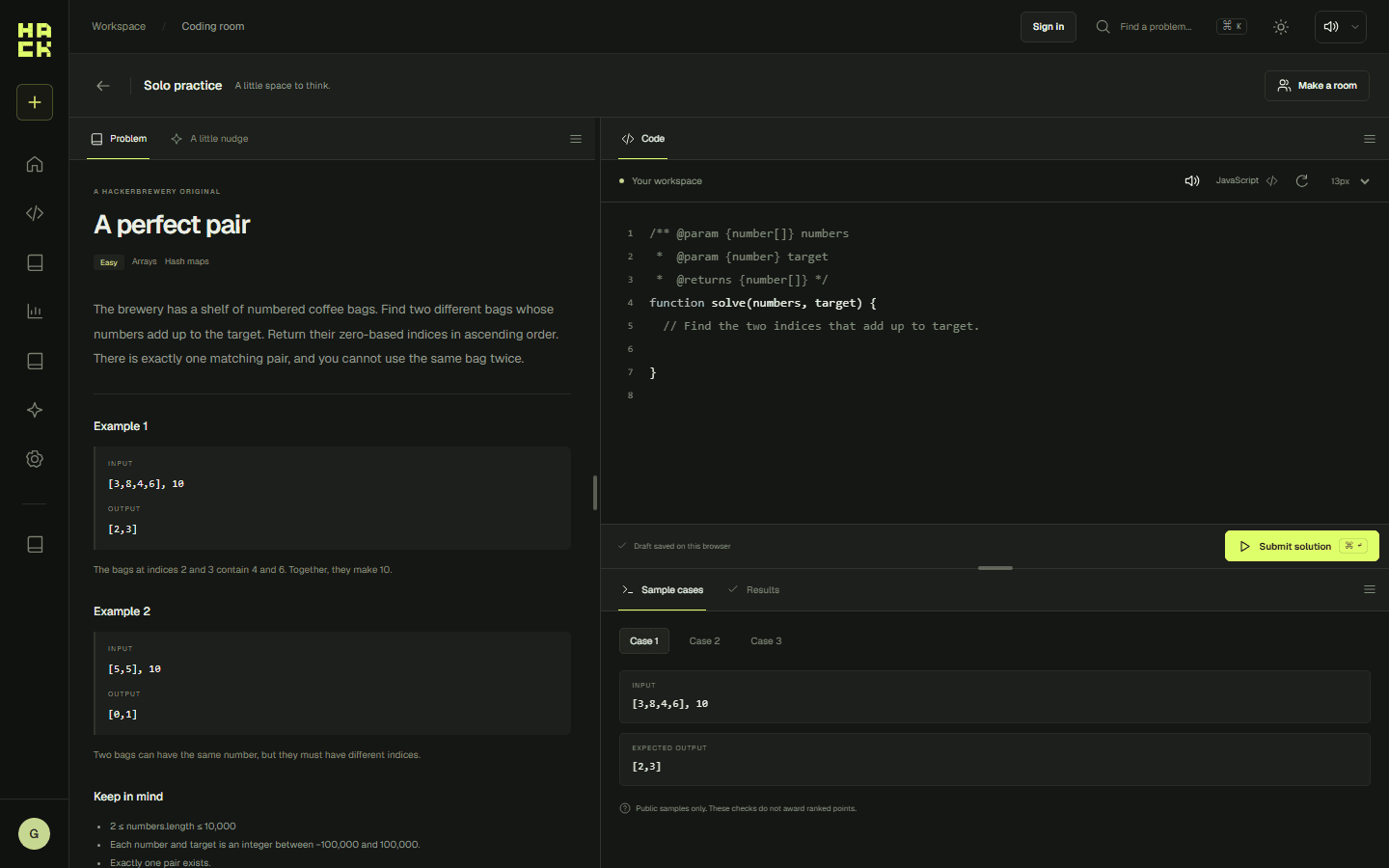
Start with A perfect pair and see how each of you finds the two numbers.
Need a hand? support@hackerbrewery.com